

Blog9 min read
Vibe Coding and the One-Person Company: Build One Useful Thing Extremely Well
A practical playbook for turning one real need into a focused one-person AI company using a live voice API, user-owned memory, and a seven-day validation loop.
By Ntense
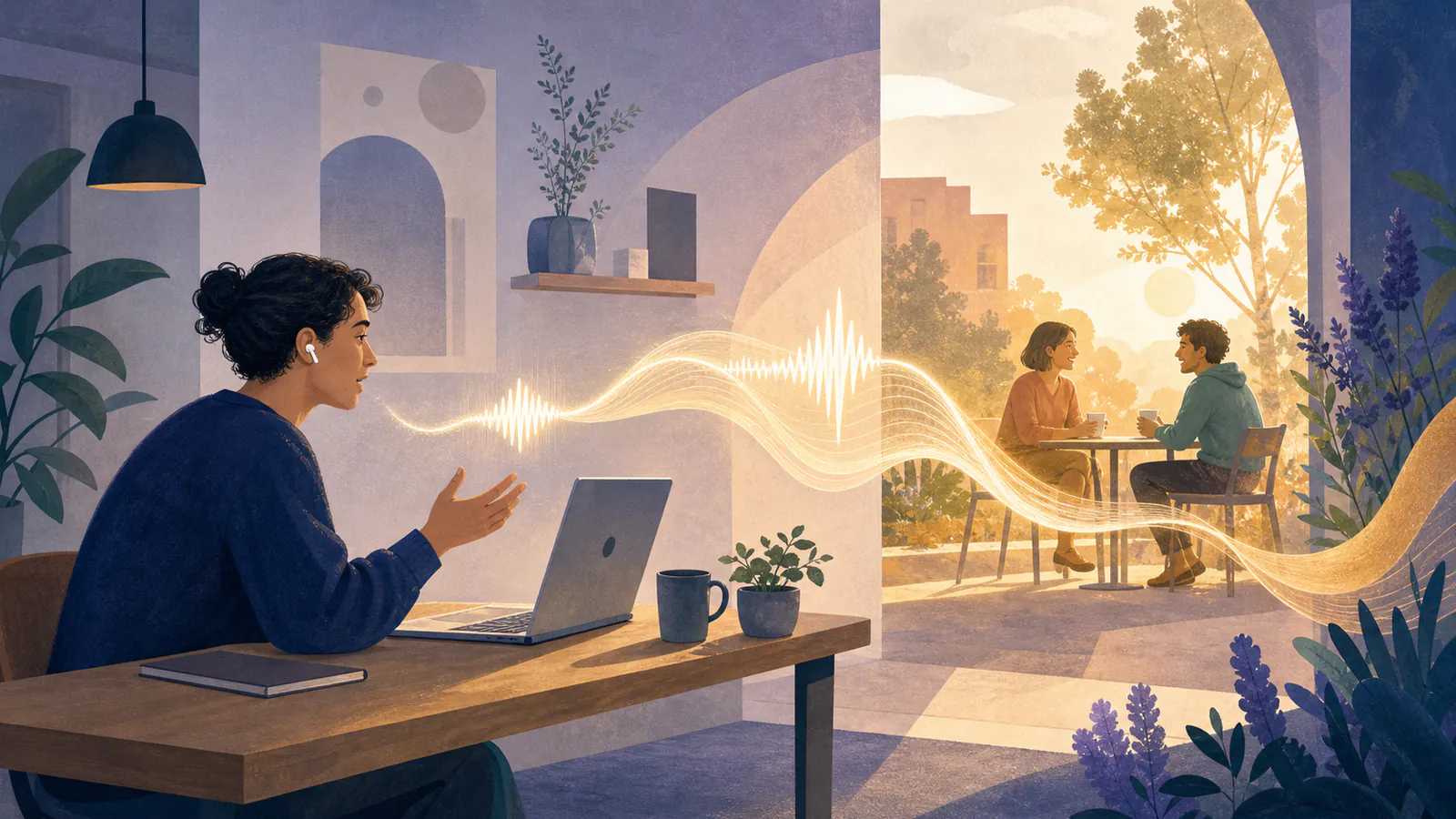
Vibe coding has made it possible for one person to build what once required a product team. Lower development cost does not make product judgment less important. It makes judgment the main event.
The opportunity for a one-person company—an OPC—is not to learn every model, framework, agent pattern, and database. It is to find one painful need, solve it with the smallest workable technology, and make the experience so focused that a user cannot imagine returning to the old way.
The product does not need a new foundation model. A realtime voice API, a small database, and a carefully designed memory layer are enough for the first version. The difficult work is choosing the need, narrowing the user, earning trust, and making every interaction feel exceptionally good.
Elon Musk described the product insight
Do not copy the surface idea and build another general chatbot. Extract the need underneath it.
- Some people find it difficult to begin a conversation or need more time and psychological safety before expressing themselves.
- A human friend may not be available at the exact moment support is needed.
- Most AI chats forget the relationship, so every session feels like starting again. A useful companion must be consistent, patient, and continuous.
The opportunity is not artificial friendship as entertainment. It is dependable conversational continuity that helps a person reconnect with human life.
The real need is social connection
The step could be rehearsing a family call, preparing for a difficult conversation with a manager, replying to a friend, practising an introduction before a community event, or reflecting on what went well afterward.
The AI is not the destination. It is the bridge.
The product: One Good Call
1. One tap to talk
No prompt box, character marketplace, or dashboard full of modes. The home screen has one primary action: Talk now. The user speaks, can interrupt naturally, and can pause without the product making the silence uncomfortable.
2. Remember only what helps
After a conversation, the app proposes a few short memory cards, such as a sibling's name, a planned Sunday call, or the observation that preparing the first sentence makes phone calls easier. The user approves, edits, or rejects each memory. Nothing important is silently saved.
At the next call, the companion can recall the plan and offer to rehearse the opening. That small moment is the product. The model is replaceable. Trusted continuity is not.
3. Prepare one human action
Every session should converge on one small, specific action. The companion can draft a message, rehearse a first sentence, role-play a likely response, or reduce an overwhelming task into one step. “Make more friends” is not an action. “Send Alex this two-sentence message” is.
4. Follow up without guilt
Later, the app asks one neutral question: How did it go? If the action did not happen, the companion makes the next attempt smaller instead of producing shame or motivational noise. If it did happen, the app records what helped.
5. Return the user to people
The companion should suggest appropriate human contact: a friend, family member, peer group, community activity, or qualified professional. It should never imply that it is conscious, demand loyalty, discourage outside relationships, or present itself as a therapist. A successful session ends with more human agency, not more dependence.
Make one feature extreme: user-owned continuity
The companion should explain why it recalled something, allow memory to be disabled, and let sensitive memories expire automatically. The user should be able to switch the underlying AI provider without losing approved history.
This is the practical interpretation of Musk's “Don't turn off my friends” line. Do not pretend a server can be immortal. Design the product so a provider outage, model migration, or company failure does not erase the user's history. For an intimate AI product, portability is part of emotional safety.
The first version needs very little technology
Browser microphone
    -> Realtime voice API
    -> Session summary
    -> User-approved memory cards in a relational database
OpenAI's Realtime API supports low-latency speech-to-speech agents and recommends WebRTC for browser or mobile clients that capture and play audio directly. Google's Gemini Live API likewise supports low-latency voice interactions over a stateful connection.[3][4]
Choose one provider. Do not spend the first month comparing both. Use a mobile-friendly web app, WebRTC audio, a hosted PostgreSQL database, ordinary tables for users and approved memories, a scheduled reminder job, and simple product analytics.
- No model fine-tuning, multi-agent system, or vector database on day one.
- No native mobile apps, animated avatar, or custom voice model in the MVP.
- No complex retrieval pipeline, companion marketplace, or twenty personalities.
Let real user friction purchase complexity.
What extreme product execution actually means
- The user can begin speaking within seconds; interruption feels natural; the companion never rushes a pause.
- Names and relationships are recalled accurately; every saved memory is user-approved; deletion and export require no support ticket.
- Every call ends with one clear next step, the follow-up remembers it, and an API failure never loses the conversation state.
A competitor can call the same API in an afternoon. It cannot instantly reproduce hundreds of observed details about what makes a hesitant user feel safe enough to speak and ready enough to act. That product knowledge becomes the moat.
Build and validate it in seven days
- Interview ten adults who avoid calls, delay replies, or rehearse conversations. Ask about the last time it happened, the emotion, the workaround, and the consequence. Look for “I needed this yesterday,” not “That sounds cool.”
- Write one promise: Talk for five minutes; leave with the words and confidence to contact one person. Remove any MVP idea that does not strengthen it.
- Build one screen, connect the live voice API, save a structured session summary, and let the user approve three memory cards. Do not build billing, avatars, social features, or provider switching.
- Build the action and follow-up loop. End each call with one step, let the user schedule a reminder, and record what made the attempt easier or harder.
- Onboard five users personally. Watch where they hesitate, what they refuse to share, when the AI speaks too much, and whether the suggested action is useful. Do not explain a confusing interface. Fix it.
- Ask for a two-week commitment, a small founding-member payment, or a scheduled weekly feedback call. Evidence of commitment is more useful than compliments.
Measure human progress, not AI activity
More messages and longer sessions may indicate value, but they may also indicate dependence. Track first-session completion, sessions ending with an approved action, real-world actions attempted, week-four retention, memory corrections or deletions, and self-reported confidence around a planned conversation.
Safety is part of the product
The Musk example involves a child, but an OPC should start with adults. Products for minors require a higher standard of consent, age assurance, parental controls, content safety, crisis handling, privacy, and independent review.
Even an adult MVP must disclose that the companion is AI, ask before storing memories, collect minimal data, encrypt it, provide immediate deletion and export, prevent coercive or exclusivity-seeking behaviour, route crisis language toward human help, avoid diagnosis, and test failures with people outside the founding team.
Trust is not a legal page hidden in the footer. Trust is what the product does at the most vulnerable moment.
How this becomes a one-person company
The founder does not perform every task manually. The founder owns the judgment loop. Use AI to write code, generate tests, analyse anonymised feedback, draft onboarding copy, create support tools, and document operations. Use managed services for authentication, the database, analytics, email, and payments.
Keep the human work where it matters: interviewing users, reviewing sensitive failures, deciding what the companion must never do, improving the core conversation, and earning distribution through trusted communities.
Start with one audience and one channel, such as an adult social-skills community, disability employment service, or peer-support organisation. Do not buy broad consumer ads for an intimate product before understanding retention and safety.
If the loop works, adjacent opportunities include job-interview preparation, newcomer social confidence, elder connection, language practice, and support after a major life transition. Expand only after one group loves the first product.
Escape learning hell
Learning hell begins when education is disconnected from a user and an outcome. A course on agents leads to retrieval, fine-tuning, and five more prerequisites. Months later, the learner knows the vocabulary but has never watched one person use something they made.
- Find a painful event and speak to the person who experiences it.
- Build the smallest complete loop and put it in their hands.
- Learn only what the failure demands: WebRTC for latency, memory design for bad recall, privacy for low trust, or positioning when users return but will not pay.
A huge opportunity can hide inside a small promise
Vibe coding does not guarantee a successful company. It removes enough production friction for one person to search for product truth much faster. The winning OPC will understand one human problem in unreasonable detail and turn a simple technical capability into a complete, trusted experience.
The raw technology already exists. The company is built in the last mile: who you serve first, which moment hurts, what the product remembers, what it must never do, and which real-world action proves it helped.
Find one real need. Build the complete loop. Make that loop exceptional.
Sources
- In Conversation with Rishi Sunak — Elon Musk Archive Accessed Sat Aug 01 2026 00:00:00 GMT+0000 (Coordinated Universal Time). The transcript records Musk describing an AI companion with memory, conversations that build over time, the ‘Don't turn off my friends’ remark, and his suggestion that an AI friend might help a son who has learning disabilities and difficulty making friends.
- Social Connection Linked to Improved Health and Reduced Risk of Early Death — World Health Organization Accessed Sat Aug 01 2026 00:00:00 GMT+0000 (Coordinated Universal Time). Reports that about one in six people globally experience loneliness, notes high rates among young people and additional barriers for some people with disabilities, and says digital technology should strengthen rather than weaken human connection.
- Realtime and Audio — OpenAI Accessed Sat Aug 01 2026 00:00:00 GMT+0000 (Coordinated Universal Time). Documents low-latency speech-to-speech voice agents and recommends WebRTC for browser and mobile clients that capture or play audio directly.
- Gemini Live API Overview — Google AI for Developers Accessed Sat Aug 01 2026 00:00:00 GMT+0000 (Coordinated Universal Time). Documents low-latency realtime voice interactions, continuous audio streams, and stateful WebSocket connections for Gemini Live API applications.